
THE ROI MIRAGE
When AI creates more activity but fewer deals
A VP Sales at a €300M B2B software company usually does not ask for more AI generated emails. They ask why the pipeline looks fuller while conversion gets worse. That pattern shows up when generative AI is pointed at volume instead of fit: reps get more leads, SDRs send more outreach, and revenue ops inherits a mess of weak accounts that never matched the ICP.
ICP SIGNALS
The ICP signal stack has to do more than copy firmographics
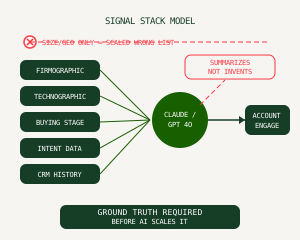
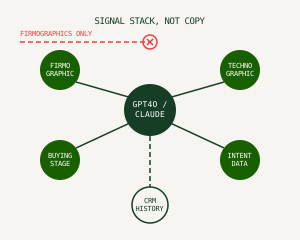
If your ICP still starts with company size, geography, and industry, GenAI will dutifully scale the wrong list faster. The better pattern is a signal stack: firmographic fit, technographic overlap, buying stage behaviour, intent data, CRM history, and account engagement. A model like Claude or GPT 4o can summarise those signals, but it cannot invent missing ground truth.
In practice, the winning teams give the model a narrow brief: identify accounts that resemble closed won deals, not accounts that merely look large. That means feeding it patterns from Salesforce, Outreach, 6sense, Bombora, website events, and product usage where available. A clean ICP beats a clever prompt every time, because the prompt only works with the evidence you hand it.
TOOL BREAKDOWN
LLM retrieval helps reps think faster; scoring helps teams prioritise
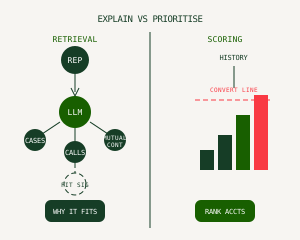
LLM plus retrieval works best when the task is explanation, not ranking. A rep asks why an account matters, and the model pulls relevant case studies, prior call notes, mutual contacts, and product fit signals from a knowledge base. Predictive scoring still does a different job: it estimates which accounts are more likely to convert based on historical patterns, which is the better fit for prioritisation and routing.
"The mistake is assuming one model can both explain the account and decide the account." — AI To Market, 2026. For ROI, that distinction matters. Retrieval driven GenAI can cut time spent preparing account plans, but predictive scoring is what changes queue order, territory assignment, and SDR coverage. If you want revenue impact, separate the workflow, then measure each layer against pipeline outcomes.
EVIDENCE ANCHORS
Enterprise deployment fails on governance before it fails on model quality
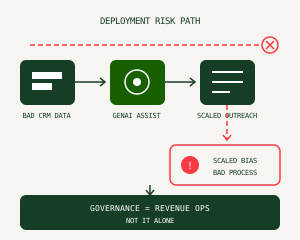
The largest deployment risk is not that GPT 4o writes a weak email. It is that sales leadership lets the model touch bad data, stale territories, unapproved claims, or inconsistent ICP rules. Once a GenAI assistant starts drafting outreach from polluted CRM fields, it scales bias and bad process. That is why governance has to sit with revenue ops, not only IT.
Change management is usually slower than the prototype. Reps trust tools that save time and reject tools that feel like surveillance. If you want adoption, put the model inside familiar workflows such as Salesforce, HubSpot, Salesloft, or Outreach, and keep a human approval step for the first two months. The best early win is not automation; it is confidence.
“It is that sales leadership lets the model touch bad data, stale territories, unapproved claims, or inconsistent ICP rules.”
PIPELINE DELIVERY
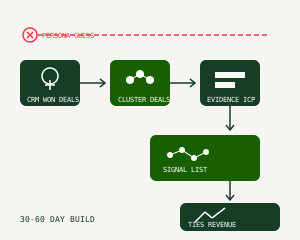
A 30 to 60 day build that ties ICP quality to revenue
Define the ICP from closed won evidence: Pull 12 to 24 months of won deals from Salesforce or your CRM, then cluster them by industry, deal size, product mix, and sales motion. Do not let marketing rewrite the ICP from persona slides alone; the model needs evidence from real revenue — LinkedIn (2026). Build a signal list, not a generic lead list: Combine firmographic data with intent, website activity, and prior engagement from tools like 6sense, Bombora, and first party web events. A narrow list of 500 high fit accounts usually beats 5,000 broad accounts because routing and follow up stay focused. Add retrieval for account context: Use Claude, GPT 4o, or a vector search layer to pull account history, case studies, and prior meeting notes into one summary for reps. The goal is faster account planning, but you must limit the source set or the model will mix approved facts with stale notes. Test one prioritisation rule before full automation: Use a simple scoring overlay to rank accounts by ICP match and engagement, then compare it with existing territory queues. If the new order does not improve conversion or meeting acceptance within two cycles, stop and revise the signal mix. Instrument ROI from the start: Track MQL to SQL rate, meeting acceptance, and stage conversion before and after the pilot. If reps save time but pipeline quality does not improve, the deployment is a productivity tool, not a revenue tool.
Frequently Asked Questions
Key Takeaways
Revenue teams win when GenAI is forced to prove fit, not generate noise
- Start with closed-won accounts, not with prompts.
- Use GenAI for account context and drafting, not blind prioritisation.
- Keep ICP rules, territory logic, and approval rights under revenue ops control.
- Measure pipeline quality, not just output volume.
- If the pilot does not change conversion, it is not an ROI case.