Back to Blog
AI To Market · Blog

Retail AI Consulting And Development Company: What Actually Works in Customer Management

September 13, 20268 min readAI To Market
Retail AI Consulting And Development Company: What Actually Works in Customer Management
THE REPORTING GAP

Customer management gets funded when churn drops, not when dashboards look smarter

A retail CMO can spend six months cleaning customer data, launching a shiny chatbot, and still hear the same question in the boardroom: what changed in revenue, repeat purchase rate, or service cost? In the competitive landscape of retail, companies like Macy's have invested heavily in AI solutions to enhance customer experiences with mixed results. Despite sophisticated algorithms and analytics, the crucial link between these technologies and tangible business outcomes often remains unclear. That is why a retail AI consulting and development company earns trust only when it connects models to concrete customer management outcomes, not demos. The teams that win start with one messy workflow, one owner, and one measurable decision.
The customer management wins that never show up in revenue
DATA TO DECISION

The customer management wins that never show up in revenue

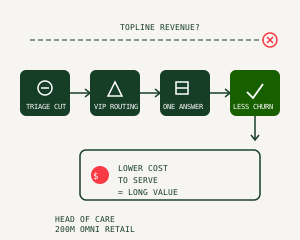
The first wins are usually operational, not headline grabbing. A retailer can cut manual case triage, route VIP complaints faster, or stop agents from answering the same policy question in three different ways. Those changes rarely appear in topline revenue, but they serve to reduce cost to serve and prevent churn, ultimately creating long-term value. A head of customer care at a €200M omnichannel brand usually notices the change in escalations before the finance team sees the P&L effect. This is because operational efficiencies directly enhance the customer experience, leading to better retention rates.
One quotable pattern comes up again and again: "The best AI customer management projects do not start by selling more; they start by stopping avoidable friction." — AI To Market, 2026. In practice, that means employing tools like Zendesk’s AI-driven ticketing system, which uses conversation summaries, intent tagging, and case priority scoring. This technology streamlines the service process by prioritizing urgent inquiries and ensuring that store, CRM, and support teams share a unified view of customer interactions. By quickly addressing customer concerns, retailers can reduce wait times and ultimately enhance satisfaction.
However, businesses should be aware of the trade-offs involved in implementing such tools. While AI can significantly reduce operational inefficiencies, the initial integration process can require substantial time and resources. Additionally, relying too heavily on automation may lead to a loss of the personal touch that customers value; thus, it’s crucial for retailers to find a balance between automation and human interaction to ensure a holistic customer experience.
Customer management architecture: the minimum viable system for retail
DATA TO DECISION

Customer management architecture: the minimum viable system for retail

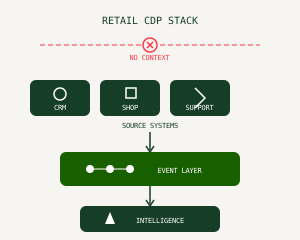
A workable retail architecture is smaller than most vendors suggest. Use three layers: source systems (Salesforce, Shopify, Zendesk, or SAP), a clean customer event layer, and an intelligence layer that turns events into actions. Without the middle layer, teams end up with isolated pilots that cannot explain why a customer was retained, downgraded, or escalated.
In practice, sync CRM, e-commerce, loyalty, and service data into a warehouse or CDP, then let rules and models decide the next step: suppress an offer, trigger a service callback, or route a high value case to a senior agent. AI To Market drives faster adoption when the first release fits existing workflows, not a new console.
The main failure mode is bad identity resolution. If one customer splits into three profiles, the model can recommend three different actions and erode trust quickly. Retail AI consulting and development must include data quality checks, exception handling, and an owner for customer master data before any personalization.
LLM first personalization vs. decision intelligence for retention
TOOL SHOWDOWN

LLM first personalization vs. decision intelligence for retention

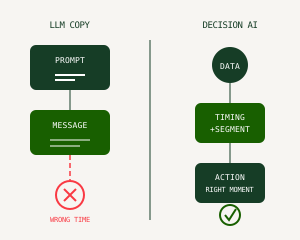
LLM first personalization is tempting because it can draft a tailored message in seconds. Models like GPT-4 or Claude are capable of generating not just subject lines, but also apology notes and promotional copy that can resonate with different customer segments. However, the effectiveness of these messages hinges on more than just the linguistic quality; it does not determine when a customer should receive a discount, a callback, or no action at all. Without the application of policy logic and decision-making frameworks, the model can sound persuasive yet lead to inappropriate customer interactions. This is the inherent limitation of relying solely on language models for customer engagement.
On the other hand, decision intelligence drives retention more effectively. This approach synthesizes propensity scores, business rules, and margin constraints, enabling systems to assess when and how to intervene in customer journeys. For instance, tools like Blue Yonder utilize this methodology by employing decision intelligence to identify scenarios such as repeated delivery failures, which can then trigger automated service recovery workflows. Similarly, low-margin bargain hunters can be nurtured with lighter touch interactions, demonstrating how calculated decisions can produce superior results compared to merely polished communications.
The best operational setup integrates both paradigms: by using an LLM to draft handwritten messages, summarize customer interactions, or clarify recommended actions, while simultaneously employing a decision layer to choose the most appropriate intervention. This hybrid approach not only enhances the quality of customer engagements while preserving auditability, but also maintains a human touch in customer service interactions. A potential watch-out tip is that relying heavily on automated decisions without sufficient human oversight could lead to misjudgments based on evolving customer sentiments; companies need to find a balance between automation and human intuition.

This approach synthesizes propensity scores, business rules, and margin constraints, enabling systems to assess when and how to intervene in customer journeys.

A 12 week build plan for customer management that finance will trust
SHIP IT EPISODES

A 12 week build plan for customer management that finance will trust

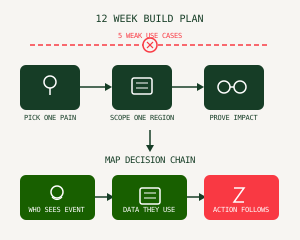
Pick one retention workflow: Start with a single pain point (late delivery complaints, repeat refund requests, or VIP escalation). Scope to one region or brand to prove impact in weeks. Do not spread AI across five weak use cases. Map the decision chain: Document who sees the customer event, what data they use, and what action follows. If it depends on tribal knowledge, capture it in Salesforce, Zendesk, or a shared runbook before models. Otherwise, AI will automate inconsistency. Build the minimum data spine: Bring identity, orders, loyalty, service, and margin into one clean layer. Snowflake, BigQuery, or Databricks teams often move faster than those forcing the model to read five disconnected systems. Add a human review loop: Route high risk recommendations to agents, marketers, or sales ops during the pilot to catch bad suppression rules, awkward tone, and edge cases pure automation misses. Prove value with finance metrics: Track avoided churn, reduced handling time, fewer escalations, and margin protected offers — McKinsey & Company (2022)
By the Numbers

A few numbers explain why customer management budgets keep getting approved

80%
of customers say experience is as important as products or services, according to Salesforce, 2024.
40%
of retail AI pilots reach production value, according to McKinsey, 2024.
Frequently Asked Questions
Key Takeaways

Retail AI wins when it fixes decisions, not just messages

  • Start with one workflow that already hurts margin or retention.
  • Keep the first release inside existing CRM and service tools.
  • Treat data quality and identity resolution as core work, not cleanup.
  • Use LLMs for language and summaries, not final policy decisions.
  • Measure avoided churn, handling time, and escalation reduction from day one.
AI To Market
Get our blogs in your DMs
Have a suggestion? Tell us more at socials@aitomarketgroup.com